
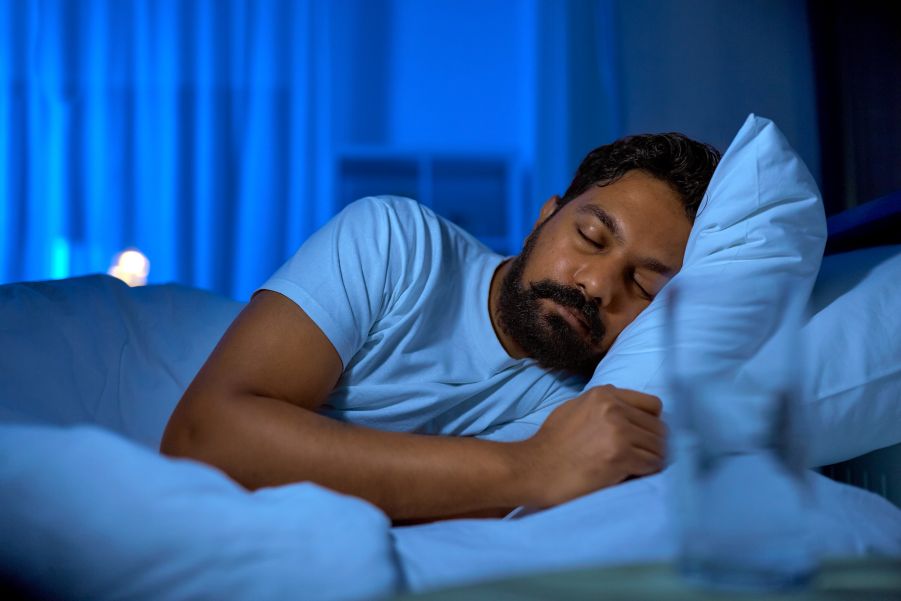
In the United States, adults are recommended to get at least 7 hours of sleep each night. However, about 20% of U.S. adults report getting only about 6 hours of sleep per night. Many things can make it harder to get enough sleep. Blue light from phones, computers, and TVs, scrolling through social media late at night, and caring for children can all interfere with sleep.
Sleep is important for many functions in the body. When normal sleep is disrupted, it can affect hormone levels, including testosterone. Poor sleep can also affect thinking, mood, muscle function, weight, and sexual function.
Sleep Quality and Testosterone
Men’s hormone levels follow a daily cycle. This means testosterone levels are usually higher in the morning and slowly decrease throughout the day. When sleep is disrupted, it can interfere with the body’s ability to make testosterone. Some studies have found a complex link between sleep and testosterone. For example, in some groups of men, getting more sleep did not always mean having higher testosterone levels. However, this does not mean that getting less sleep is better for testosterone or overall health.
Poor or prolonged sleep can increase cortisol, a hormone that helps the body respond to stress. Higher cortisol levels may interfere with the body’s normal hormone production, including testosterone. This is one reason why getting enough good-quality sleep is important for maintaining healthy hormone levels.
Sleep quality is also important. It is not just about how many hours you spend in bed. Good-quality sleep allows your body to move through its normal sleep cycles and get enough deep, restorative sleep. Frequent waking or poor-quality sleep can interrupt these cycles and may affect hormone production. Poor sleep can also increase cortisol, a hormone that rises with stress and can interfere with normal hormone production.
Slow-wave sleep is an important part of deep, restorative sleep. It happens more often during the first half of the night. Frequent waking during this time can reduce the amount of deep sleep you get. This means that two people who sleep for the same number of hours may not get the same benefits if one has more broken or interrupted sleep.
Sleep Disruptions and Testosterone
Conditions such as obstructive sleep apnea (OSA) and insomnia can affect sleep quality and may be linked to lower testosterone levels. Both conditions can cause frequent waking and may reduce the amount of deep, restorative sleep you get. OSA occurs when the upper airway repeatedly narrows or closes during sleep. This can cause brief awakenings as the body works to reopen the airway. Insomnia can make it difficult to fall asleep, stay asleep, or get enough good-quality sleep.
Shift work may also affect sleep and hormone levels. Working outside normal daytime hours, such as on the evening or night shift, can disrupt the body’s natural sleep-wake cycle. Over time, this may affect sleep quality and the normal daily pattern of hormone production.
Key Takeaways
- Sleep is important for testosterone production and many other functions in the body.
- Frequent waking during the night can interrupt deep, restorative sleep and may affect testosterone production.
- Conditions such as OSA and insomnia can disrupt sleep. Shift work can also interfere with the body’s normal sleep-wake cycle.
- Long-term lack of sleep can increase cortisol levels, which may interfere with normal hormone production.
- If you regularly have trouble falling asleep, staying asleep, or getting good-quality sleep, consider speaking with your doctor or a sleep specialist.
Resources
CDC. (2025, February 12). About sleep. United States Government. U.S. Centers for Disease Control and Prevention. https://www.cdc.gov/sleep/about/index.html
Davuluri, T., Aslot, V., Seliger, B. J., Edgington, A., Nadiminty, N., Shah, T., & Sindhwani, P. (2025). Sleep deprivation: A lifestyle risk factor for male infertility. Uro, 5(3), 17. MDPI. https://doi.org/10.3390/uro5030017
Hernández-Pérez, J. G., Taha, S., Torres-Sánchez, L. E., Villasante-Tezanos, A., Milani, S. A., Baillargeon, J., Canfield, S., & Lopez, D. S. (2023). Association of sleep duration and quality with serum testosterone concentrations among men and women: NHANES 2011-2016. Andrology, 12(3), 518–526. Wiley Online Library. https://doi.org/10.1111/andr.13496
Wittert, G. (2014). The relationship between sleep disorders and testosterone. Current Opinion in Endocrinology, Diabetes & Obesity, 21(3), 239–243. ResearchGate. https://doi.org/10.1097/med.0000000000000069
You may also be interested in...
SMSNA Patients
Is Oral Testosterone Safe and Effective for Men With Low Testosterone?
January 24, 2023Did You Know?
What Is the Connection Between Low Testosterone and COVID-19 Hospitalizations?
October 11, 2022Blog
How Does Sleep Affect Your Sex Life?
July 19, 2022SMSNA Patients
PSA and Total Testosterone Levels in Men With Prostate Cancer
April 26, 2022SMSNA
Rethinking Testosterone Replacement Therapy in Men With Prostate Cancer
May 11, 2022SMSNA Patients
Testosterone May Play a Role in COVID-19, Says New Research
July 13, 2021SMSNA Patients
A Possible Future Treatment Option for Male Hypogonadism
April 6, 2021SMSNA
Diagnosing Testosterone Deficiency in Men
June 10, 2021Other Popular Articles
What Is the Average Penis Size?
If you have ever wondered how your penis compares to others in terms of size, you are not alone. Many men are curious to know how their penises stack up compared to the average. Unfortunately, general curiosity can sometimes give way to full-on obsession and anxiety about penis size. This can be an unhealthy and often unnecessary fixation, especially because most men who think their penises are too small have perfectly normal-sized penises.

Can Sex Reduce Menstrual Cramps?
The SMSNA periodically receives and publishes ‘guest editorials.’ The current article was submitted by Mia Barnes, a freelance writer and researcher who specializes in women's health, wellness, and healthy living. She is the Founder and Editor-in-Chief of Body+Mind Magazine.
Having sex while you experience menstrual cramps is healthy and can provide significant benefits. While it might not be the first activity that comes to mind when your PMS or period cramping begins, many people enjoy sex to reduce menstrual cramps, experience increased pleasure and benefit from other advantages. Learn more about having sex while menstrual cramps are happening and how it can help your body.
What Is Sensate Focus and How Does It Work?
Sensate focus is a technique used to improve intimacy and communication between partners around sex, reduce sexual performance anxiety, and shift away from ingrained, goal-oriented sexual patterns that may not be serving a couple.

What Is Jelqing, and Does It Actually Work?
The term “jelqing” refers to a set of penis stretching exercises that some believe can make the penis bigger. Although the practice has gained attention and popularity in blogs and internet forums in recent years, there is no scientific evidence that it is an effective way to permanently increase the size of one’s penis. In fact, in some cases, jelqing may actually cause damage to the penis, so it is a good idea to get all the facts before setting off to try it.

How Long Does It Take the Average Man to Ejaculate?
On average, it takes a man between 5 to 7 minutes to orgasm and ejaculate during sexual intercourse.
Can Sex Throw off Your Vaginal pH Balance?
The SMSNA periodically receives and publishes ‘guest editorials.’ The current article was submitted by Mia Barnes, a freelance writer and researcher who specializes in women's health, wellness, and healthy living. She is the Founder and Editor-in-Chief of Body+Mind Magazine.
Your vagina is a pretty powerful organ. It is a pathway for menstrual blood and babies. It also is a main player in sexual intercourse. You might hear about your vagina’s pH and worry that yours is at risk. Here’s what to know about vaginal pH, including the impacts sex could have.
Attention: Restrictions on use of SMSNA content in third party applications, including artificial intelligence technologies, such as large language models and generative AI.
You are prohibited from using or uploading content you accessed through this website into external applications, bots, software, or websites, including those using artificial intelligence technologies and infrastructure, including deep learning, machine learning and large language models and generative AI.