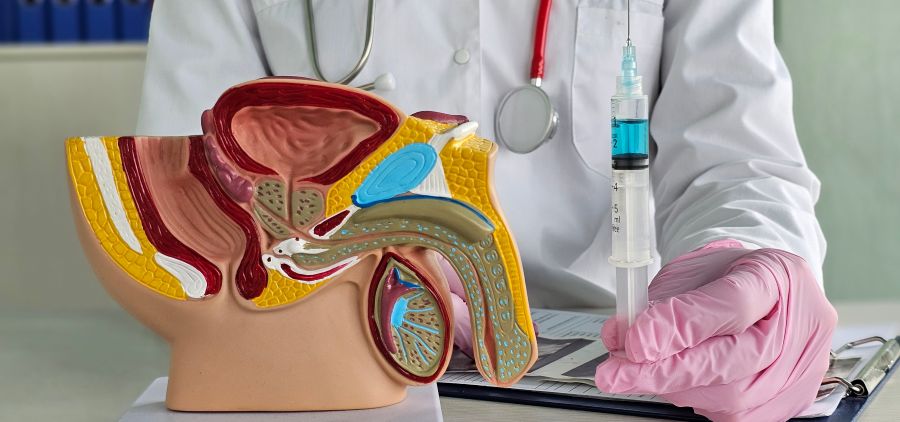
Peyronie’s disease (PD) occurs in up to 18% of men and is characterized by the development of fibrous plaque on the tunica albuginea in the penis. This plaque, often caused by microtrauma from surgery, sex, or other experiences, can cause the penis to curve or deform when erect.
This article aims to provide an overview of the American Urological Association (AUA) and Canadian Urological Association (CUA) guidelines regarding PD and its treatments.
The AUA and CUA guidelines are relatively similar, specifying that specific treatment depends on the degree of curvature, presence of erectile dysfunction, and stage of disease.
There are currently no treatments recommended for the acute or active phase of PD (when the plaque is still forming); however, new research has been investigating options for treating the active phase. All recommended treatments as of 2018 are meant for the chronic or stable phase of PD (when the plaque has hardened).
What to Consider
Oral medications, including non-steroidal anti-inflammatories (NSAIDs) for erectile pain during the active phase, and PDE5-i for erectile dysfunction (ED).
Collagenase intralesional injections involve injecting into the most acute area of fibrous plaque, laterally, accompanied by both clinician-manual modelling and at-home modelling. This method should only be recommended for patients with a curvature between 30° and 90°, with good erectile function, a stable disease state, and the presence of non-calcified plaque on ultrasounds.
Verapamil intralesional injections are currently considered part of the standard of care in many places. Some studies have shown some potential benefits to curvature and pain, while others have not shown much improvement. Both the CUA and AUA recommend conditional use of these injections.
Penile traction has a Grade C recommendation by the CUA and is included in the AUA’s Core Curriculum on Peyronie’s Disease as a reasonable option. This may be recommended for those in both the acute and chronic phases of PD, but is most helpful when used early, and best when used in combination with other methods. If patients cannot fully commit, then it is not recommended that they use this method. Most studies have reported an average improvement in curvature of roughly 33%, with patients reporting improvements in penile length, curvature, and successful sexual intercourse.
Penile plication is best for patients with good erectile function and pre-operative penile rigidity without medication, and with an uncomplicated curve between 30° and 60° with no significant deformity.
Plaque incision or excision with grafting is best for patients with normal erectile function with or without medication, complex penile curvature of less than 60°, large plaque(s), short penile length, and other deformities.
Penile prosthesis placement is recommended for PD when significant erectile dysfunction is present. The prosthesis may be performed in combination with other procedures such as manual modeling (bending), plication, or incision/grafting. Providers should establish if patients would prefer a completely straight penis or if the functionally straight measurement of 20° is acceptable. Generally, penile curvature should improve over time with repeated activation of the device.
What to Avoid or Recommend Experimentally
Oral therapy with vitamin E, tamoxifen, procarbazine, omega-3 fatty acids, or a combination of vitamin E with L-carnitine. Recent research has studied tamoxifen as an option for the acute phase, but the results do not provide strong evidence yet.
Verapamil gel or electromotive therapy is not recommended by either association.
Extracorporeal shock wave therapy (ESWT) has a conditional recommendation for the treatment of penile pain only. However, research is continuously evolving in this area.
Radiation therapy should not be used in any case.
Platelet-rich plasma (PRP) is not recommended for the treatment of PD due to a lack of reliable data. However, more recent research shows potential and therefore may be considered experimentally.
Key Takeaways
- Peyronie’s disease has a higher prevalence rate than one might think and causes distressing sexual dysfunction and pain.
- Decisions for treatment modalities should be a collaborative process with the patient, and should consider the degree of curvature, disease progression, and presence of erectile dysfunction.
- Research is constantly evolving regarding PD treatments. These could be considered for experimental or investigational therapy.
- The AUA and CUA have roughly the same recommendations for PD treatment. Only minor differences occur, likely due to cultural or political differences.
- Choosing the right therapeutic option for patients does not have to be stressful.
Resources
Bella, A. J., Lee, J. C., Grober, E. D., Carrier, S., Benard, F., & Brock, G. B. (2018). 2018 Canadian Urological Association guideline for Peyronie’s disease and congenital penile curvature. Canadian Urological Association Journal, 12(5). https://doi.org/10.5489/cuaj.5255
Nehra, A., Alterowitz, R., Culkin, D. J., Faraday, M. M., Hakim, L. S., Heidelbaugh, J. J., Khera, M., McVary, K. T., Miner, M. M., Nelson, C. J., Sadeghi-Nejad, H., Seftel, A. D., Shindel, A. W., & Burnett, A. L. (2015). Peyronie’s Disease (2015). Peyronie’s disease guideline - american urological association. (2015). https://www.auanet.org/guidelines-and-quality/guidelines/peyronies-disease-guideline
Sandean DP, Leslie SW, Lotfollahzadeh S. Peyronie Disease. [Updated 2024 Oct 6]. In: StatPearls [Internet]. Treasure Island (FL): StatPearls Publishing; 2026 Jan-. Available from: https://www.ncbi.nlm.nih.gov/books/NBK560628/
Shah, M., Megson, M., Al-Mitwalli, A., Fratangelo, R., Shergill, P., Shahzad, R., Di Giovanni, A., Zhang, J., Lee, W. G., Ralph, D. J., & Cellek, S. (2026). Evaluation of a combination of off-label PDE5 inhibitor and tamoxifen in acute Peyronie’s disease. The Journal of Sexual Medicine, 23(6). https://doi.org/10.1093/jsxmed/qdag120
You may also be interested in...
Did You Know?
Do ED Medications Increase One’s Risk of Vision Problems?
May 3, 2022SMSNA Patients
How Affordable Are Erectile Dysfunction Treatments Around the World?
March 8, 2022Did You Know?
The Facts About Vaginal Health and Feminine Hygiene
January 11, 2022SMSNA
Disorders of Ejaculation Guideline Highlights for APPs
June 9, 2022SMSNA Patients
New Survey Reveals Men Prefer Telemedicine
October 19, 2021Did You Know?
Why Does Sex Hurt?: A Guide for Figuring Out What Might Be Causing Painful Sex
June 22, 2021SMSNA
Online Treatments for Male Sexual Dysfunction in the Time of COVID-19
October 22, 2021SMSNA Patients
Low-Intensity Shockwave Therapy May Be Beneficial for Women With Provoked Vestibulodynia
February 23, 2021Blog
An Overview of Concealed Penis
February 16, 2021Other Popular Articles

What Is the Average Penis Size?
If you have ever wondered how your penis compares to others in terms of size, you are not alone. Many men are curious to know how their penises stack up compared to the average. Unfortunately, general curiosity can sometimes give way to full-on obsession and anxiety about penis size. This can be an unhealthy and often unnecessary fixation, especially because most men who think their penises are too small have perfectly normal-sized penises.

Can Sex Reduce Menstrual Cramps?
The SMSNA periodically receives and publishes ‘guest editorials.’ The current article was submitted by Mia Barnes, a freelance writer and researcher who specializes in women's health, wellness, and healthy living. She is the Founder and Editor-in-Chief of Body+Mind Magazine.
Having sex while you experience menstrual cramps is healthy and can provide significant benefits. While it might not be the first activity that comes to mind when your PMS or period cramping begins, many people enjoy sex to reduce menstrual cramps, experience increased pleasure and benefit from other advantages. Learn more about having sex while menstrual cramps are happening and how it can help your body.

What Is Sensate Focus and How Does It Work?
Sensate focus is a technique used to improve intimacy and communication between partners around sex, reduce sexual performance anxiety, and shift away from ingrained, goal-oriented sexual patterns that may not be serving a couple.

What Is Jelqing, and Does It Actually Work?
The term “jelqing” refers to a set of penis stretching exercises that some believe can make the penis bigger. Although the practice has gained attention and popularity in blogs and internet forums in recent years, there is no scientific evidence that it is an effective way to permanently increase the size of one’s penis. In fact, in some cases, jelqing may actually cause damage to the penis, so it is a good idea to get all the facts before setting off to try it.

How Long Does It Take the Average Man to Ejaculate?
On average, it takes a man between 5 to 7 minutes to orgasm and ejaculate during sexual intercourse.
Can Sex Throw off Your Vaginal pH Balance?
The SMSNA periodically receives and publishes ‘guest editorials.’ The current article was submitted by Mia Barnes, a freelance writer and researcher who specializes in women's health, wellness, and healthy living. She is the Founder and Editor-in-Chief of Body+Mind Magazine.
Your vagina is a pretty powerful organ. It is a pathway for menstrual blood and babies. It also is a main player in sexual intercourse. You might hear about your vagina’s pH and worry that yours is at risk. Here’s what to know about vaginal pH, including the impacts sex could have.
Attention: Restrictions on use of SMSNA content in third party applications, including artificial intelligence technologies, such as large language models and generative AI.
You are prohibited from using or uploading content you accessed through this website into external applications, bots, software, or websites, including those using artificial intelligence technologies and infrastructure, including deep learning, machine learning and large language models and generative AI.
Subscribe for our Newsletter!